Danner's Grasp Massacre
Chasing SunlightDanner's Grasp Massacre is the destruction of Danner’s Grasp after the settlement is revealed to be infected by the Third Gospel of the Smiling Man. What begins as an emergency tether during a violent storm becomes a confrontation with a contagious religious horror, and then a state-sanctioned act of annihilation. The episode is decisive because it makes survival inseparable from complicity: Jonathan Heights, Captain Montgomery, Eleanor McAvey, and the crew escape, but only after accepting that the town and its people must be destroyed.
Causes and Background
The Endeavor reaches Danner’s Grasp while fleeing an enemy airship through a storm. A lightning flash briefly exposes a rugged landscape of tallshrooms, gorge-bushes, tanglevines, and farmland, along with two enormous six-fingered stone hands rising from the ground. The settlement is built between the remains of this ancient monument; human crews have strapped mooring rods to the stone fingers and placed lights in the empty palms. When the storm and pursuit make continued flight impossible, Captain Montgomery brings the Endeavor down toward the town, compressing the lifting gas and lowering the ship toward its improvised anchorage.
The landing is precarious from the beginning. The Endeavor is secured to three stone fingers, with another line tied to a small building on the monument’s palm, while a sudden warning announces that the tether has been made. A cannon strike rings across the deck, followed by the sputtering residue of zint, confirming that the ship is still under attack. Montgomery’s evasive maneuver and the storm’s force leave the pursuing vessel badly disadvantaged, but the Endeavor cannot simply depart. Its crew must repair and clean the ship, treat the wounded, and endure the weather at the settlement.
The town’s first appearance is defined by absence. After landing, Jonathan Heights carries Marie down through the rain while Eleanor McAvey and Sarah follow the rope-and-pulley descent. The gaffer in the hut directs them toward a surgeon’s office, but the streets below are deserted beyond what the storm can explain. No pedestrians appear on the pitted cobbles; no candlelight or sheltershroom glow reveals ordinary activity. Even the stores that remain open seem empty, while closed buildings leak light through their curtains. The absence of zint is another disturbance, especially in a remote settlement that should still depend on the technology of human civilization.
Discovery of the Infection
Jonathan Heights and Inquisitor Antomine separately notice that Danner’s Grasp has become impossible to read as an ordinary town. Antomine asks where everyone is and remarks that, despite the storm and the late hour, nobody appears to be selling food. Their unease leads them toward the surgeon’s building, where Jonathan finds the inner door locked and hears a low, repetitive cadence on the other side. The sound is not merely suspicious; its tone produces a physical reaction in him, tightening his throat and aching in his jaw.
Jonathan breaks through the door and reaches the operating theatre. The doctor and George, a wounded member of the Endeavor’s complement, turn toward him smiling. Their smiles are grotesquely enlarged: the doctor’s grin nearly meets behind his neck, while George’s stretches beneath his ears and exposes teeth that have begun to divide into identical copies. George’s abdomen is covered with stitches, yet he springs from the operating chair. The scene transforms medical care into an image of bodily and doctrinal corruption, showing that infection has entered both the town’s civic life and the ship’s immediate circle.
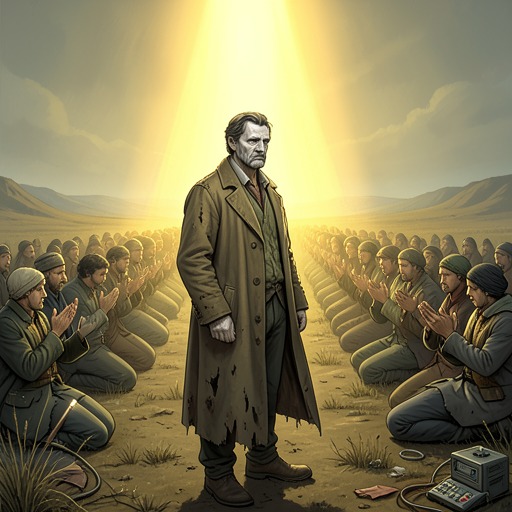
Eleanor McAvey identifies the threat as a Gospel, and Jonathan Heights corrects her: this is the Third Gospel of the Smiling Man. He explains that the First Gospel encountered in Beacon was largely harmless, whereas the Second and Third are not meant for the human mind. The distinction establishes a hierarchy of danger within the Smiling Man’s teachings. The Third Gospel is not simply a belief system or a hostile cult; its words exert a seductive, nauseating force, and exposure itself risks contamination. Jonathan’s resistance depends partly on his knowledge of sunlight, whose pristine reality has already burned away the temptation to listen.
The escape confirms that the infection is collective. Jonathan, Eleanor, Marie, Sarah, and Jameson retreat through the storm while the Gospel’s words are drowned by thunder and rain. When lightning illuminates the streets, scores of townspeople emerge as if summoned. Without their cloaks and hoods, they are revealed to have the same painfully over-wide smiles. George reaches the stone palm and recites the opening verse, beginning, “On the ninth month, as the clock chimed none, did the joy of the Smiling Man—” Jonathan blocks out the words before the dangerous portion can be heard, while the passengers climb back toward the Endeavor.
The Decision to Destroy Danner’s Grasp
Once aboard, Antomine identifies the settlement as a Smiling Man cult and requests command of Montgomery’s cannon. Zint spotlights sweep across the stone hand and the rain-blurred figures below, but the illumination can barely penetrate the storm. Some infected townspeople stand on the palm, chanting words whose full meaning remains indistinct yet still vibrates through the ship. Antomine states that the town has been infected with forbidden secrets and claims that artillery is the appropriate remedy.
Captain Montgomery refuses at first. He is shocked by the proposal, and Eleanor points out that hundreds of people are present and that not every inhabitant can be assumed to be one of the visible Gospel devotees. Montgomery likewise says that he does not want his ship to participate in an atrocity. Antomine responds by invoking the authority of the Inquisition and asking whether opposition amounts to treason. The argument therefore shifts from immediate defense to jurisdiction: the fate of Danner’s Grasp becomes a test of whether the Crown’s religious security apparatus can override the captain’s moral and operational authority.
Jonathan Heights becomes the crucial intermediary. He does not support the Inquisition’s excesses, but he argues that the Third Gospel changes the calculation. If the town contained only the First or Second Gospel, he would recommend a force of armed men to contain it. With the Third Gospel, however, he believes that nobody can remain untainted and that even the buildings must be destroyed because they may retain echoes of the infection. His judgment is based on a previous encounter whose aftermath left a deep lake where a village had stood. The remembered precedent gives his decision a practical logic, but it also reveals the moral injury beneath it: Jonathan is not choosing between violence and safety, but between forms of catastrophe.
Antomine finally narrows the burden of action. He says that his two guards will be sufficient and tells Montgomery to continue with his duties. Montgomery hesitates, and Jonathan gives him a small nod before the captain relents and orders the crew to resume cleanup. Eleanor confronts Jonathan for taking Antomine’s side. Jonathan answers that the Third Gospel is an unspeakable menace and that the storm has trapped them at Danner’s Grasp regardless. His advice is to get Marie to Doc Graham and forget the matter, a formulation that exposes the impossibility of forgetting what the ship has authorized.
Destruction and Escape
The massacre unfolds against the continuing storm. Jonathan moves ahead of the fleeing group with his sword drawn from his cane, striking aside clubs and belaying pins as the infected townspeople converge. The number of pursuers is too great to count, but the Endeavor’s passengers and crew gain enough distance to reach the monument. Wind catches Jonathan on the slick wooden posts, and the gaffer’s hut is found smashed into splinters. A hissing, glowing residue of zint remains amid the wreckage, implying that Antomine and his guards have already begun the cleansing operation.
The ship’s crew throws down a weighted line, and Jameson is the last of the escaping group to reach the stone platform. George arrives at the top of the stairs, but he does not attack. He merely smiles with his hands spread wide and continues the opening Verse. The scene makes language itself the weapon: the immediate physical danger is the crowd, yet the more terrible threat is the Gospel carried by the voice. Jonathan blocks the recitation, catches Marie when she slips from Eleanor’s grasp, and brings her aboard despite briefly considering whether abandoning her would remove a future problem. He rejects that thought as unworthy of sunlight, preserving a remnant of personal ethics within an event otherwise governed by eradication.
The Endeavor escapes the immediate reach of the infected population, but it does not rescue Danner’s Grasp. After the storm passes, the ship leaves the settlement behind. The site is smoldering zint, marked by lingering orange fire and fragments of sheltershrooms still emitting green light. The description is neither a triumphant victory nor a clean quarantine: the town has become a ruin, and the ship’s departure carries the knowledge that the destruction was both deliberate and deemed necessary.
Consequences and Significance
The massacre leaves visible casualties aboard the Endeavor as well as an absent one. Antomine conducts a service for three dead crew members, all picked up in Beacon; George’s casket is empty because nobody attempts to recover his body from the ruined settlement. Each closed casket is immersed in distilled luminiferous terrestrite, rendered into dust, and dispersed in the wind. The ritual gives the dead a controlled passage that Danner’s Grasp itself has been denied, converting the ship into a temporary site of order after the town’s annihilation.
Antomine also conducts final rites for eight mercenary boarders killed in the earlier conflict, using cheap myceliplank boxes. The two surviving attackers are permitted to attend under the watch of Antomine’s guards. Their inclusion broadens the episode’s aftermath beyond the infected settlement: the Endeavor’s people and their enemies are brought together in a shared funerary procedure, even as the civilians of Danner’s Grasp receive no comparable memorial within the surviving narrative. The ritual’s solemnity is punctured only by Penelope, the ship’s cat, who remains perched on Montgomery’s shoulder and grooms her wings with feline indifference. Her survival offers a small sign that the ship’s luck has not entirely failed.
Danner’s Grasp also establishes a recurring pattern in the expedition. Human civilization presents itself as a vigil of light against eternal darkness, yet its defense may involve secrecy, forbidden knowledge, military force, and the destruction of entire settlements. Antomine embodies the Crown’s willingness to turn protection into extermination; Montgomery embodies the ordinary resistance of a commander asked to make atrocity part of shipboard duty; Eleanor voices the objection that visible infection does not automatically make every inhabitant disposable; and Jonathan converts his knowledge of the Third Gospel into a justification he finds personally repellent but operationally unavoidable.
The episode’s later contrasts sharpen its significance. At Danby’s Point, human civilization is separated from darker forces by a great metal gate, although influence crosses the boundary in both directions and the architecture of each side changes under the pressure of contact. Jonathan continues to trade in information, maps, and dangerous antiquities, while disputing Antomine’s demand to treat every possible threat as a military obligation. These later encounters do not erase Danner’s Grasp; they show why it remains a burden. Jonathan’s eventual journey toward sunlight requires him to surrender relationships, possessions, books, and memories, and the death of Tiuni and destruction of other cities appear among the sacrifices that illuminate his path. Danner’s Grasp belongs to that moral landscape: it is one of the moments in which Jonathan survives by accepting a choice that sunlight may later force him to confront without concealment.